The U. s. economy is objectively awful right now. The unemployment rate is at levels not seen since the Great Depression and this quarter”s decline in the gross domestic product is expected to be the worst on record. Most economists believe it will take years to recover from this recession.
Not everyone thinks the economy is doing so poorly, though that.
In the most recent Quinnipiac University national survey, 69 percent of Republicans described the U.s. economy as “excellent” or “good.” Similarly, nearly two-thirds of the Republicans in both Civiqs”s daily tracking polls and in the June 11-15 Associated Press/NORC Poll said, that the nation’s current economy is at least leaning toward the good. By contrast, only around 10 percent of Democrats thought that the national economy was doing well in those surveys.
In fact, a closer look at Civiqs data shows that Democrats’ and Republicans’ views of the economy are more polarized now than they’ve been at any point from the President’s Trump”s time in office.

That isn’t to say that, and the Democrats Republicans have seen eye-to-eye on the economy at previous points in Trump”s presidency. They haven t.
As you can see in the chart above, there has been a fairly-large — and-persistent — gap-in-how-and-Democrats Republicans think about the economy. However, that gap did shrink after the pandemic”s dire economic effects became apparent, and by early May, only one-third of Republicans still thought that the economy was in good shape.
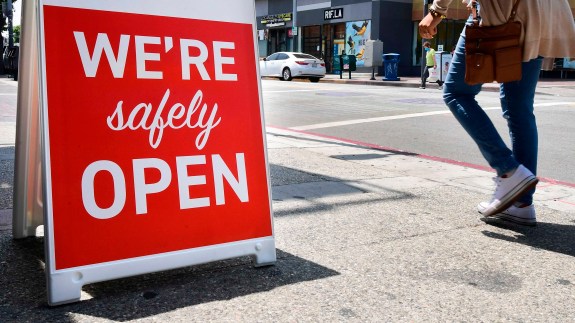
Republicans’ economic optimism, however, quickly rebounded in June, with the states allowed businesses to reopen and the May jobs report was released, with better-than-expected news.
Even when Republicans’ outlook on the economy was at its lowest point this year, according to Civiqs date, they still felt more upbeat about the state of the economy than at any point in 2016 before Trump was elected, when the economy was objectively better.
This isn’t you do not have permission surprising, though, that the political science research has found that the strong economy might not benefit the president in the as much as it once did-in part, because voters’ views on whether the economy is healthy tend to be linked whether to their preferred party is in power. That said a lot about how polarized our politics have become, and it also underscores the key point is that, as John Sides, Lynn Vavreck, and I have repeatedly made about the 2016 election: The widespread economic dissatisfaction and anxiety driving much of the the average account about Trump”s political rise and the 2016 presidential campaign wasn’t a reflection of the current economic reality, it was largely a consequence of partisanship.
Of course, the difficulty is that these attitudes aren’t just partisanship, either. After eight years of Obama”s presidency, racial, and economic anxiety became increasingly understood intertwined to the point that racial resentment was a little stronger, predictor, of economic pessimism under Obama than it had been under George W. Bush. That is, the white people — especially the white Trump’s voters — believed that Black people were ” getting ahead, while they were left behind.
Take the 2016: American National Election Studies, a survey. Before Trump took the office, the more racial discrimination by white people, thinking their own, the group faced, the more likely they were to say that the economy was worse than it had been a year earlier. These voters largely voted for Trump. But under the Trump”s presidency, the a similar poll found that white voters were less likely to say the economy had gotten worse if they believed that white people faced high levels of racial discrimination.

In addition, nearly three-quarters of the 69,000 respondents surveyed for the Thanks to the Fund + the WORLD Nationscape in the past three months have said that the economy is worse than it was a year ago. But only around half of the white respondents who think their racial group) faces a lot or a great deal of discrimination shared in this economic pessimism. (This was true even after controlling for several other from brazil, such as partisanship and income.)
In other words, the terms’ political allegiances and their views on race can influence their views of the economy. That marks a significant departure from the last time there was an economic downturn during the presidential election campaign. The act, regardless of their partisanship, and racial attitudes, universally thought the economy was in terrible shape after the financial collapse in 2008.
But that isn’t the case now. So why is the coronavirus recession so different?
One reason is that, even though the national economy is in shambles, it’s also ticking back up. It’s unclear how fast the economy will recover, but this uncertainty opens the door for voters to change their own partisan and racialized explanations for the economy’performance. Additionally, in a presidential election where the incumbent had a long planned to base his case for reelection on a strong economy, Americans are all the more motivated to view the economy through political lenses.
Not to mention, Trump has also tried to bend the country”s bleak economic reality to his will. He has said that the economy is springing back from the coronavirus recession-like “the rocket ship,” claiming if the economic recovery is “on the way to the greatest comeback in American history.” This is very different from 2008, when a few Republicans made the case that the economy was in good shape. At the time, GOP presidential nominee John McCain was even widely mocked it is saying, “the fundamentals of our economy are strong” before quickly reversing his position is to say, the economy was in “total crisis.”
But now, the fact that the most economists disagree with the president’s optimism about a quick rebound may not matter. All we’ve seen with the Civiqs date, more Republicans think the economy is in “good shape” now than thought so in the end of 2016. And a long line of social science research shows that when political elites are sharply divided — as they are now over-the-economy — the public follows the lead of the elites,. That is, partisan messaging, and is now so powerful, that the Act tend to change their party”s standpoint even if that position runs counter to the science or the objective facts.
And that’s what makes the coronavirus recession so different. Americans are increasingly understood unlikely to abandon their partisan, and racialized views of the economy. So as long as the Trump project’s role in building confidence, Republicans will likely continue to have a little more positive view of the economy than the Democrats for jo.
